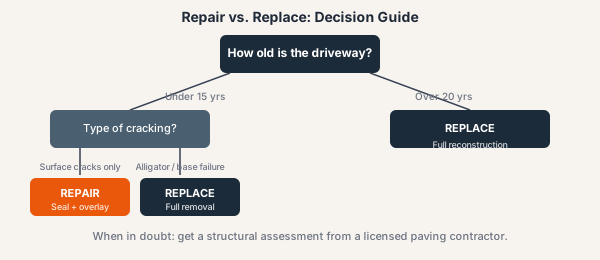
That cracking driveway might need a $2/sq ft overlay, or it might need a $6/sq ft replacement. It comes down to whether the foundation underneath is still solid. Here's how to figure it out before you pay for the wrong fix.
The Core Question: Surface Problem or Structural Problem?
Asphalt driveways fail from the top down or from the bottom up. Understanding which one you're dealing with determines the right fix.
Top-down deterioration is caused by UV oxidation, water infiltration through surface cracks, and fuel/chemical damage. The asphalt binder hardens and becomes brittle, leading to surface cracking and weathering. The base is still solid. This is repairable.
Bottom-up failure starts with base problems: soft spots in the subgrade, poor drainage, inadequate base depth, or freeze-thaw heaving. Once the base fails, the asphalt surface has nothing stable to rest on. No amount of surface repair fixes a failed base. This requires removal and reconstruction.
Repair: When an Overlay Is Appropriate
A 1.5–2 inch asphalt overlay is appropriate when:
The driveway is under 20 years old and has been reasonably maintained. Older driveways may not hold an overlay well due to overall oxidation of the binder.
Cracks are surface-level only. Hairline cracks, longitudinal cracks along the length, and minor transverse cracks that haven't widened significantly are signs of surface aging, not structural failure.
No soft spots. Walk the driveway and note any areas that feel spongy underfoot or show rutting in warm weather. Soft spots indicate base problems. A few isolated soft spots may be repairable separately; widespread soft areas mean base failure.
The driveway drains properly. Water ponding on the surface suggests either a drainage design problem or base settlement. Both of which may be structural.
Edges are in good shape. Edge crumbling and drop-offs at the sides of the driveway suggest base erosion, which an overlay won't fix.
If the driveway passes these checks, an overlay extends service life by 10–15 years at $1.50–$3.00/sq ft versus $4–$7/sq ft for full replacement. Our asphalt calculator can estimate the tonnage needed for a 2-inch overlay on your driveway area.
Replace: When You Need Full Reconstruction
Full removal and replacement is necessary when:
Alligator cracking is present. This is the pattern of interconnected cracks that looks like an alligator's hide. It indicates base failure. The subgrade can no longer support the asphalt above it. Overlaying alligator-cracked asphalt just pushes the problem upward.
Age is over 25 years with significant visible deterioration. Very old asphalt with heavy oxidation won't bond well to a new overlay. The existing material may be so brittle that it cracks through the overlay quickly.
Significant deformation. Ruts deeper than 1/2 inch, settled sections, or areas with substantial grade changes suggest base movement that an overlay won't correct.
Water damage at the base level. Soil staining visible at cracks, persistent soft spots, or driveway sections that have heaved and dropped all point to base damage from water infiltration.
The base was never adequate. Some driveways were installed over minimal or no base preparation. If repairs haven't held and the driveway has never performed well, it may simply need to be rebuilt correctly from the subgrade up.
The Walk-Through Assessment
Here's what to look for in your driveway assessment:
Visual check:
- Gray surface (normal oxidation) vs. crumbling surface (serious deterioration)
- Crack pattern: linear/surface vs. alligator
- Edge condition: clean edges vs. crumbling
- Water pooling areas
Physical check:
- Walk slowly across the full surface, especially after rain when soft spots are most obvious
- Look for any area that deflects or springs underfoot
- Check the center strip where tire loads concentrate
Age and history:
- When was it installed?
- Has it been sealcoated and maintained?
- Has it had any overlay work already?
- Any history of drainage problems?
The Cost Comparison
Let's take a 40×20 foot (800 sq ft) driveway:
| Option | Cost Estimate | Material Needed |
|---|---|---|
| Sealcoat only | $120–$400 | NA |
| 2" overlay | $1,200–$2,400 | ~9.7 tons HMA |
| Full replacement | $3,200–$5,600 | ~14.5 tons HMA |
The overlay is the right choice when structurally appropriate. However, a bad overlay over a failing base will crack through within 2–5 years, wasting the investment.
For exact material tonnage calculations, use our free asphalt calculator with your driveway's actual dimensions.
Getting a Professional Assessment
When you're not sure, a paving contractor can assess the structural condition in about 15–30 minutes. A reputable contractor will core the existing asphalt (remove a 4-inch diameter plug) to inspect the base and measure existing thickness. Most do this free as part of a bid.
Get two or three assessments. If two contractors recommend overlay and one recommends replacement, the replacement recommendation needs justification. Replacement is a larger ticket, so verify before committing.
For a full guide to ongoing driveway care, read our asphalt driveway maintenance guide.