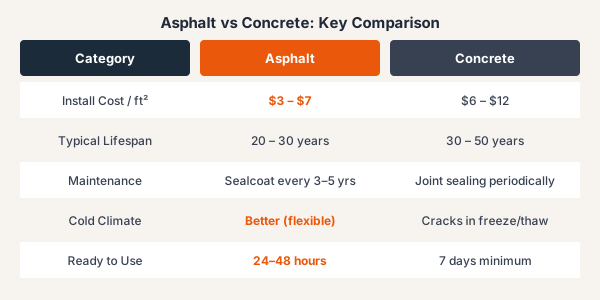
Asphalt driveways typically cost $3 to $7 per square foot installed. Concrete runs $6 to $12. Asphalt is cheaper up front, no question. But the right pick for your house depends on where you live, how long you're staying, and how much upkeep you'll actually do.
The Core Trade-Off
Asphalt is cheaper upfront and handles freezing climates better. Concrete lasts longer and needs less upkeep.
If you're in Minnesota, Michigan, or anywhere that sees repeated freeze-thaw cycles, asphalt's flexibility is a genuine advantage. Asphalt bends slightly with ground movement rather than cracking. Concrete is rigid. It fractures when the ground shifts under it, and repairs are more visible and complex.
If you're in Florida, Arizona, or another hot climate, the trade-off flips. Asphalt softens in sustained heat above 120°F, which can cause rutting in high-traffic areas. Concrete stays rigid. It also reflects more heat than asphalt, keeping adjacent surfaces cooler.
Cost Comparison Over 30 Years
Sticker price isn't total cost. Here's what each material typically costs per square foot over a 30-year period:
Asphalt:
- Install: $4–$7/sq ft
- Sealcoating (every 3–5 years × 8 applications): $0.30–$0.60/sq ft per application
- Crack filling and minor repairs: $0.50–$1.50/sq ft total
- Possible resurfacing at year 15–20: $1.50–$3/sq ft
- 30-year total: approximately $8–$16/sq ft
Concrete:
- Install: $6–$12/sq ft
- Joint sealing and crack repairs: $0.50–$2/sq ft total
- No resurfacing typically needed before year 30
- 30-year total: approximately $7–$14/sq ft
Over 30 years, the two end up closer than the sticker price suggests. Concrete loses some of its cost edge once you price in the fact that asphalt usually needs a resurface or two. Asphalt keeps its advantage in freeze-thaw country, where cracked concrete slabs sometimes get replaced long before the 30-year mark.
Use our paving cost calculator to get accurate material tonnage figures before getting contractor quotes.
Climate Is the Deciding Factor
Cold climates (USDA zones 3–6): Asphalt is the stronger choice. The FHWA's pavement design guidance for northern states reflects this. State DOTs in Minnesota and Wisconsin use HMA for residential road construction far more than concrete. The material handles frost heave and thermal contraction without the cracking issues concrete faces.
Hot and arid climates (zones 8–10): Concrete holds up better. High-traffic areas on asphalt, such as the strip in front of your garage door, can develop ruts from the weight of a parked car over a hot summer. White or light-colored concrete also reflects solar heat more effectively.
Moderate climates: Either works well. In the mid-Atlantic states, the Midwest below zone 5, and most of the Pacific Northwest, your choice comes down to budget and aesthetics.
Maintenance Requirements
Asphalt requires more active maintenance than concrete, but the tasks are straightforward.
Every 3–5 years, you should apply a sealcoat to protect the binder from UV oxidation and fuel spills. DIY sealcoating with a squeegee applicator costs $0.05–$0.15/sq ft. Skipping it allows the surface to gray, crack, and deteriorate faster.
Fill cracks annually before water infiltrates and expands during freeze-thaw. Rubberized crack filler in a caulk gun handles anything under half an inch wide.
Concrete is more hands-off. The main maintenance task is joint sealing: the pre-formed expansion joints are filled with a flexible sealant and need attention every 3–7 years. Stains (oil, rust) are harder to treat on concrete than on sealed asphalt.
Repair and Patching
Asphalt is easier to patch inconspicuously. A well-executed asphalt patch blends into the surrounding surface as both age. Cold Mix is available at any hardware store for DIY pothole repair.
Concrete patches are visible. Matching color and texture with existing concrete is difficult, and saw-cut repairs leave visible seams. For appearance-critical driveways, this matters.
Environmental Considerations
Both materials are largely recyclable at the end of their service life. Asphalt is actually one of the most recycled construction materials in the US. Over 80% of old asphalt pavement gets reclaimed and reused in new mixes, per the National Asphalt Pavement Association (NAPA).
Concrete production has a higher embodied carbon footprint per cubic yard than asphalt, primarily because of Portland cement's manufacturing process. For projects where lifecycle carbon matters, asphalt typically has an edge.
The Practical Decision
Choose asphalt if: You're in a cold climate, working with a tighter budget, want faster usability (24–48 hours vs. 7 days for concrete), or plan to resell the property within 15 years.
Choose concrete if: You're in a hot or moderate climate, plan to stay long-term, want minimal maintenance, or prefer a brighter surface that doesn't retain heat.
Before committing to either, get your tonnage figured out. Our free asphalt calculator tells you exactly how much HMA your driveway requires. This is useful for comparing material costs between concrete and asphalt bids side by side.
For full installation guidance, see our asphalt thickness guide and asphalt driveway cost breakdown.