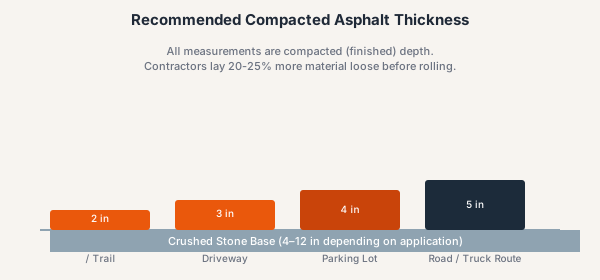
Get the thickness wrong and the whole job suffers. Go too thin, the pavement cracks and ruts inside 5 years. Go too thick, you just overpaid for tonnage nobody's going to use. The right spec depends on what you're paving and what's going to drive on it.
The Core Principle: Match Thickness to Load
Asphalt is a flexible pavement. It works by distributing load across the surface and down through a base layer into the subgrade (the native soil below). Heavier loads require thicker asphalt to prevent the surface from deflecting too much under weight.
The Federal Highway Administration (FHWA) and National Asphalt Pavement Association (NAPA) both publish pavement design guidance based on this principle. For most applications, the standards below represent minimums. Going slightly thicker improves longevity.
Thickness by Application
Residential driveways: 2–3 inches
The most common spec is 3 inches of compacted Hot Mix Asphalt (HMA) over a 4–6 inch compacted crushed stone base. This handles passenger cars, SUVs, and light pickup trucks without issue and typically lasts 20–25 years with sealcoating every 3–5 years.
Some contractors install at 2 inches to hit a lower price point. That works if the base is solid and well-compacted, and if you're only parking passenger vehicles. But 2-inch driveways show their age sooner. You'll see surface cracking and minor ruts within 10 years in cold climates.
If you park a loaded pickup, RV, or have regular delivery trucks coming in, go to 4 inches.
Light commercial parking lots: 3–4 inches
Apartment complexes, small retail, and office parking typically spec 3.5–4 inches of HMA. Higher traffic volume and the variety of vehicle weights push thickness up from residential standards.
For a 100×60 ft parking lot at 4 inches, you'd need about 58 tons of HMA. Run that through our asphalt tonnage calculator with your actual dimensions to get a precise figure.
Heavy commercial and truck routes: 4–5 inches
Loading dock areas, distribution center driveways, and any surface that sees regular loaded semi-truck traffic needs 4–5 inches minimum. Some logistics facilities go to 6 inches in high-stress zones. These applications also typically require a deeper base of 8–12 inches of crushed aggregate.
Bike paths and pedestrian walks: 2 inches
Foot traffic and bicycle loads are light. A 2-inch layer over a 4-inch compacted base is the standard for shared-use paths. Some municipalities spec 2.5 inches for durability, especially where maintenance access is difficult.
Overlays and resurfacing: 1.5–2 inches
When resurfacing over sound existing asphalt (no structural failures, just surface wear), a 1.5–2 inch overlay is appropriate. The existing asphalt must be clean, crack-free, and in good structural condition. Milling the existing surface by 1–1.5 inches before overlaying is common practice to maintain drainage grades and edge thickness.
The Compaction Factor
Most people miss this: the thickness numbers above are all compacted measurements, not the loose depth coming out of the truck.
Asphalt compacts approximately 20–25% during rolling. A contractor targeting 3 inches compacted will lay approximately 3.75 inches of loose hot mix. When the roller passes, it comes down to 3 inches.
This matters for your estimate. Our asphalt calculator uses compacted density values (145 lbs/ft³ for HMA), so the tonnage it produces is what you need delivered. This is the material that will compact down to your target thickness. No adjustment needed.
Why Base Thickness Matters as Much as Surface Thickness
The base layer under asphalt does heavy lifting. It distributes load, provides drainage, and gives the asphalt a stable surface to bond to. A thin asphalt layer over a deep, well-compacted base will outlast a thick asphalt layer over a poorly prepared base.
Standard base specs:
- Residential driveways: 4–6 inches crushed stone (AASHTO No. 57 or equivalent)
- Light commercial: 6–8 inches
- Heavy commercial: 8–12 inches
If your site has soft, clay-heavy, or poorly draining soil, the base needs to go deeper. Some sites need geotextile fabric under the base to prevent subgrade intrusion. Your contractor should evaluate the existing soil before finalizing the spec.
Real Example: Calculating Tonnage at Different Thicknesses
Let's look at a 40×20 foot driveway to see how thickness affects material needs:
| Thickness | Cubic Feet | Tons (HMA at 145 lbs/ft³) | Approx. Material Cost |
|---|---|---|---|
| 2 inches | 133 ft³ | 9.7 tons | $970–$1,455 |
| 3 inches | 200 ft³ | 14.5 tons | $1,450–$2,175 |
| 4 inches | 267 ft³ | 19.3 tons | $1,930–$2,895 |
Costs based on $100–$150 per ton. Use our driveway asphalt calculator for your exact dimensions.
The difference between 2 and 3 inches is about 4.8 tons and $480–$720 in material. For a 40×20 foot project, that's a modest premium for meaningfully better durability.
Common Thickness Mistakes
Going too thin to save money: The most common mistake. The installed cost difference between 2" and 3" on a residential driveway is modest, often $300–$600. But the performance difference over 15 years is significant.
Not accounting for the base: Some contractors quote "3 inches of asphalt" but don't address the base condition. If the gravel base is inadequate, the asphalt will fail regardless of surface thickness. Always ask what base preparation is included.
Specifying thickness without compaction testing: For commercial projects, the spec should include a compaction requirement (typically 92–96% of maximum density per AASHTO T 245). Without this, a contractor could lay looser material that meets the nominal thickness but won't perform to spec.
For a complete look at the different asphalt materials available, see our guide on hot mix vs cold mix asphalt.