Not all asphalt is the same. Construction crews work with four basic types: Hot Mix, Warm Mix, Cold Mix, and Porous. Each one is made at a different temperature, goes down a different way, and is right for a different kind of job. Pick the wrong one and you're looking at early failure or money out the window.
Hot Mix Asphalt (HMA)
Hot Mix Asphalt is the industry standard for driveways, parking lots, and roads. It's produced at temperatures between 275°F and 325°F at an asphalt plant. At those temps, the bitumen binder flows freely and coats every aggregate particle evenly, resulting in a dense, durable mix.
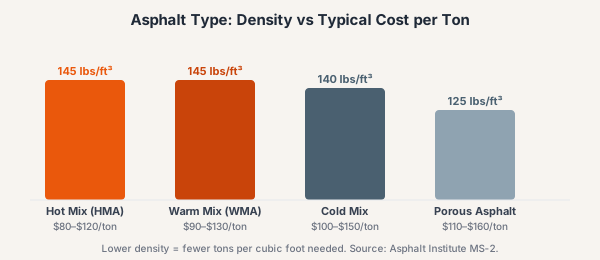
Compacted density: 145 lbs per cubic foot. This is the value used by the Asphalt Institute's MS-2 Mix Design Methods and the standard in FHWA pavement design guidance.
HMA has to be laid while hot. Once the material drops below about 175°F, it stiffens and can't be properly compacted. This means it must be paved quickly after delivery: typically within 45–90 minutes depending on ambient temperature, haul distance, and truck insulation.
HMA is what our asphalt calculator defaults to when you select "Hot Mix Asphalt." It's the right choice for:
- New residential driveways
- Parking lot construction and resurfacing
- Commercial access roads
- Any full-thickness installation
Warm Mix Asphalt (WMA)
Warm Mix Asphalt is produced at lower temperatures, typically 200°F–250°F. It uses chemical additives, foaming techniques, or wax-based additives that improve workability at lower heat.
The density is identical to HMA: 145 lbs/ft³. The tonnage calculation doesn't change. What changes is the production process and its advantages:
Lower emissions: Less fuel burned in production means less CO₂ per ton. WMA is increasingly specified on sustainability-focused projects.
Longer haul times: Material stays workable longer at lower temperatures, making it practical for projects farther from the plant.
Extended paving season: WMA can be laid at lower ambient temperatures than HMA, extending the paving window into fall.
The trade-off: WMA typically costs $5–$15 per ton more than HMA due to additives. For standard residential work, HMA remains the default choice. For large commercial projects or regions with strict emissions rules, WMA is worth considering.
Cold Mix Asphalt
Cold Mix is an emulsified asphalt product mixed with fine aggregate at ambient temperature. It comes in bags or bulk quantities, requires no plant equipment, and can be applied without heating.
Density: 140 lbs/ft³. This is slightly lower than HMA due to higher void content and the nature of the emulsion process.
Cold Mix is not a substitute for Hot Mix in full paving applications. It lacks the structural performance of HMA and won't hold up under sustained traffic when used as a surface course. Its purpose is repair work:
- Pothole filling
- Utility cut patches
- Temporary road repairs
- Small area patches (under a few square feet)
Cold Mix patches set through curing of the emulsion rather than through compaction under heat. They're workable immediately, which makes them practical for emergency repairs. Long-term performance is limited. Expect to treat them as temporary until a proper HMA repair can be made.
For DIY homeowners, Cold Mix bags from a hardware store work well for filling small potholes and cracks. See our DIY asphalt repair guide for the right technique.
Porous Asphalt
Porous asphalt (also called permeable asphalt or open-graded friction course) is engineered with an intentionally high void content, typically 15–22% air voids versus 3–5% for HMA. This void structure allows water to drain through the surface and into a stone reservoir base below.
Density: 125 lbs/ft³. This is significantly lighter than HMA because of the void space.
Porous asphalt is used for:
- Stormwater management in parking lots
- Low-impact development projects
- Areas where runoff reduction is required by code
- Some pedestrian areas and parks
The installation requires a specifically designed stone base (usually 12–36 inches of AASHTO No. 57 stone) to act as a storage reservoir. Without proper base design, porous asphalt won't function as intended.
Cost is higher than HMA: $10–$30 per ton more for the specialty mix, plus the deeper base adds cost. The value proposition is regulatory compliance and stormwater fee reductions in municipalities that charge based on impervious surface area.
How Type Affects Your Tonnage Estimate
The density difference between types directly affects how many tons you'll need for a given volume:
For a 100 cubic foot project:
- HMA or WMA (145 lbs/ft³): 7.25 tons
- Cold Mix (140 lbs/ft³): 7.0 tons
- Porous (125 lbs/ft³): 6.25 tons
That 1.0 ton difference between HMA and Porous on a 100 sq ft area doesn't seem huge, but scale it to a 10,000 sq ft parking lot at 4 inches and it's a 48-ton difference. That's nearly 2.5 truck loads.
Our asphalt tonnage calculator adjusts for asphalt type automatically. Select the type from the dropdown and the density is applied in the calculation.
Which Type Should You Specify?
New driveways: Hot Mix Asphalt, 3 inches compacted, over proper base.
Commercial parking lots: Hot Mix Asphalt, 4 inches minimum.
Stormwater-sensitive areas: Porous Asphalt with engineered base (requires civil engineering input).
Sustainability projects: Warm Mix Asphalt, same thickness specs as HMA.
Pothole repair: Cold Mix for temporary; proper HMA patch for permanent.
For the right thickness spec by application type, see our asphalt thickness guide.