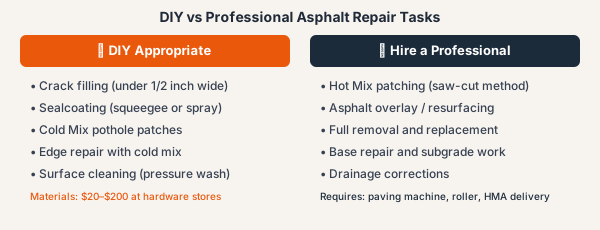
Three asphalt repairs are genuinely DIY-friendly: crack filling, sealcoating, and cold mix patching. Done right, you add years to your driveway. Done wrong, you've burned a weekend and the crack is still there.
What You Can Realistically DIY
Here's the rule of thumb: if the job doesn't need a hot plant, a roller, or a paver, you can probably handle it with a weekend and a trip to the hardware store. You're maintaining a surface, not rebuilding a pavement.
Crack Filling
What it fixes: Cracks under 1/2 inch wide caused by surface oxidation, thermal expansion/contraction, and normal aging.
What you need: Rubberized asphalt crack filler (liquid type in a squeeze bottle, or rope-type that warms up and flows in), a caulk gun if using cartridges, and a stiff brush.
How to do it:
- Clean the crack with a wire brush or compressed air. Remove all loose material, grass, and debris.
- If the crack is wide enough (over 1/4 inch), brush crack filler primer in first.
- Fill the crack from the bottom up, slightly overfilling. The material will settle as it cures.
- Smooth the surface with a putty knife or trowel before it sets.
- Allow full cure time (24–48 hours for most products) before foot or vehicle traffic.
Temperature: Apply above 50°F. Optimal range is 60–80°F. In direct sun above 90°F, filler may not cure properly.
Common mistake: Trying to fill cracks that are actually alligator cracking. The interconnected pattern of alligator cracks indicates base failure. Filling individual cracks in that pattern is treating symptoms, not the cause.
Cost: $10–$30 for enough filler to treat 20–30 linear feet of cracking.
Sealcoating
What it fixes: UV oxidation, surface brittleness, small surface pores, and fuel/chemical resistance. Does NOT fix cracks, deformation, or base problems.
What you need: Asphalt emulsion sealer or coal tar sealer, a squeegee or brush applicator (or a spray system for large areas), a pressure washer or hose for prep, painter's tape for edge protection.
How to do it:
- Pressure wash the entire driveway. Let it dry completely, typically 24–48 hours.
- Fill all cracks first. Sealer over unfilled cracks just bridges them temporarily.
- Apply sealer with a squeegee in long, even strokes. Work from one end to the other without stepping on the wet sealer.
- Apply a second coat in the opposite direction 4–8 hours after the first.
- Keep vehicles off for 24–48 hours minimum; 72 hours is better.
How much sealer to buy: A standard 5-gallon bucket covers roughly 250–400 sq ft in a single coat. A 40×20 ft driveway (800 sq ft) needs two 5-gallon buckets for a single coat, or four for two coats.
When NOT to sealcoat: Within 6 months of fresh installation. When cracks or damage hasn't been repaired first. When rain is expected within 24 hours. When temperatures will drop below 50°F overnight.
Cost: $0.10–$0.20/sq ft in materials for DIY application.
Cold Mix Pothole Patching
What it fixes: Potholes and isolated failures in the surface asphalt layer.
What you need: Cold Mix asphalt repair product (available in 50 lb bags at hardware and home improvement stores), a hand tamper or car compactor method, gloves.
How to do it:
- Remove all loose material from the pothole. A shop vacuum or compressed air helps.
- For holes deeper than 3 inches, fill in layers: no more than 2 inches per layer, tamp each layer before adding the next.
- Overfill the pothole by about 1 inch. Material will compress under tamping.
- Tamp firmly with a hand tamper or use the drive-over method (drive your car over the patch several times, adding material and tamping until the surface is flush or slightly high).
- Allow to cure according to the manufacturer's directions.
Cold Mix limits: This is a temporary-to-semi-permanent fix. A well-done Cold Mix patch can last 1–3 years under normal residential traffic. It won't match the performance of a proper hot mix patch, but it stops deterioration and prevents the pothole from growing.
For anything larger than a square foot or two, a professional hot mix patch is worth the investment.
Cost: 50 lbs of Cold Mix runs $15–$25 and fills roughly a 1 sq ft area at 3 inches deep.
What Requires a Professional
Hot mix patching: Proper pothole repair involves saw-cutting square edges, removing failed material down to stable base, and filling with fresh HMA delivered hot from the plant. This requires a saw, a dump truck, and experience. The result lasts 15+ years vs. 1–3 for Cold Mix.
Overlays and resurfacing: Laying 1.5–2 inches of fresh HMA over an existing surface requires a paving machine and roller. There's no practical DIY equivalent.
Base repair: Soft spots, sinkholes, and areas with base failure need excavation, new base material, and paving with HMA. This is always a contractor job.
Full replacement: Demolition, base prep, and fresh installation. Full contractor scope.
When DIY Repair Isn't Worth It
If more than 25% of your driveway's surface has cracking or other damage, the economics of DIY repair shift. You'd spend significant money and time treating symptoms when the driveway likely needs a full overlay or replacement.
Get a professional assessment when you're spending more than $200–$300 on DIY repairs repeatedly without improvement. Use our asphalt calculator to estimate what an overlay or replacement would cost in materials. This helps you understand whether repair or replacement makes more financial sense.
For the full maintenance schedule covering all phases of driveway care, see our asphalt driveway maintenance guide.