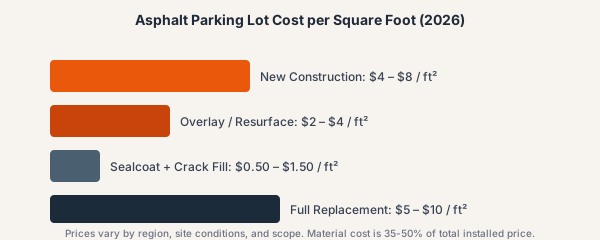
A 10,000 square foot commercial parking lot typically runs $40,000 to $80,000 for new construction in 2026. That breaks down to $4 to $8 per square foot installed. Prices swing that much because of what's underground, where you are, and how the lot is spec'd.
What the Per-Square-Foot Number Actually Buys
Commercial quotes bundle several line items into that per-square-foot rate. What a $5/sq ft bid usually gets you:
Base preparation (roughly 40 to 50 percent of the total): Grading to subgrade, 6 to 8 inches of compacted crushed aggregate. On soft or clay subgrades, plan on adding stabilization fabric or an extra 2 inches of base, which is why some bids come in higher.
Hot Mix Asphalt: Typically 3 to 4 inches compacted for light commercial traffic. At 4 inches over 10,000 sq ft, you're looking at around 242 tons of material.
Machine paving and compaction: Paver passes, plus the finish rolling needed to hit the 92 to 96 percent density target from AASHTO T 245. Short of that target and you're buying premature ravelling.
Basic striping: Parking stall lines and traffic arrows. ADA-compliant accessibility markings, blue paint, and detectable warning pads almost always cost extra.
Your quote usually won't cover: parking lot lighting, catch basins or storm drain tie-ins, concrete curb and gutter, site signage, landscape islands, or permit and engineering fees. For a 10,000 sq ft lot, those add-ons can tack on another $15,000 to $40,000.
Calculating Your Material Tonnage
Before getting bids, know your material requirement. For a 200×100 ft parking lot at 4 inches of HMA:
Volume = 200 × 100 × (4 ÷ 12) = 6,667 cubic feet
Weight = 6,667 × 145 lbs/ft³ = 966,667 lbs
Tons = 966,667 ÷ 2,000 = 483 tons
At $100–$150/ton, that's $48,300–$72,450 in material alone. Labor and base typically add 100–150% to the material cost.
Run your actual dimensions through our parking lot asphalt calculator to get the exact tonnage and estimated material cost for your project.
Resurfacing vs. New Construction
If you have an existing parking lot with surface deterioration but a solid structural base, resurfacing (overlay) is significantly cheaper than full reconstruction.
Overlay: Mill 1–2 inches of existing surface, apply 1.5–2 inch HMA overlay. Cost: $2–$4 per square foot. Extends lot life by 10–15 years.
Full replacement: Remove existing asphalt, reshape base if needed, install fresh asphalt. Cost: $5–$10 per square foot. Appropriate when base has failed or drainage must be regraded.
Whether you overlay or rebuild comes down to what's wrong with the existing pavement. Surface cracks, weathering, and shallow ruts are cosmetic, so an overlay fixes them. Alligator cracking, sinkholes, or soft spots mean the base has failed, and you can't fix a bad base by adding asphalt on top of it.
ADA Compliance and Striping Math
Any parking lot that serves the public has to comply with the Americans with Disabilities Act. That changes the math on striping costs:
- Lots with 1 to 25 stalls: 1 ADA stall required (at least one van-accessible)
- 26 to 50 stalls: 2 ADA stalls required
- 51 to 75 stalls: 3 required
- 76 to 100 stalls: 4 required
- Every additional 100 stalls: 1 more ADA stall
Van-accessible stalls need an 8-foot aisle (compared to 5 feet for standard accessible). Paint is $0.08 to $0.15 per linear foot, but the accessible icon, blue field, and hatched aisle markings together run $35 to $75 per stall installed. A 200-stall lot with 7 ADA spaces is carrying an extra $250 to $525 in striping beyond base stall lines.
For a typical retail lot, figure 1 stall per 300 sq ft of building space as the starting point for stall count, then check your local zoning minimums.
Scale Changes the Math
Unlike residential driveways, a commercial lot's price per square foot drops as the job gets bigger. Here's why: mobilization, paver setup time, and the minimum roller day-rate are fixed whether you're paving 2,000 sq ft or 50,000. Spread those fixed costs across more area and the per-foot number falls.
- 2,000 to 5,000 sq ft: $6 to $9 per sq ft
- 10,000 to 20,000 sq ft: $4 to $7 per sq ft
- 50,000+ sq ft: $3 to $5 per sq ft
If you're on the small side, bundling with a neighboring property or scheduling alongside another job on the same block can sometimes drop your rate. Contractors hate short mobilization trips.
Site Conditions That Blow Up the Budget
Four things push commercial jobs past the quoted range:
Soft or clay-heavy subgrade. Requires geotextile fabric or 2 extra inches of base. Adds $1 to $3 per sq ft across the whole lot.
Drainage work. Catch basins, French drains, or a detention pond tie-in are quoted as separate line items. Budget $3,000 to $8,000 per catch basin installed.
Milling for resurfacing. Grinding down 1 to 2 inches of existing asphalt to maintain elevation at curbs and thresholds runs $0.75 to $1.50 per sq ft on top of your overlay cost.
Plant haul distance. Hot mix has to reach the site within 45 to 90 minutes of leaving the plant or it cools below compaction temperature. If you're more than 30 miles from the nearest plant, expect a delivery surcharge or a lower-quality mix.
High-cost labor markets. New York, San Francisco, Seattle, and coastal metro areas routinely quote above $10 per sq ft installed because of union labor and permit overhead.
Typical Costs by Lot Size
| Lot Size | Square Feet | New Construction | Resurfacing |
|---|---|---|---|
| Small strip mall | 5,000 ft² | $20,000–$40,000 | $10,000–$20,000 |
| Standard commercial | 15,000 ft² | $60,000–$120,000 | $30,000–$60,000 |
| Large retail | 50,000 ft² | $180,000–$350,000 | $90,000–$175,000 |
These are material + labor installed prices. Drainage, curbing, and striping are additional.
Long-Term Maintenance Budget
After installation, budget for annual maintenance to protect your investment:
- Sealcoating every 3–5 years: $0.15–$0.40/sq ft
- Crack filling annually: $0.05–$0.15/sq ft
- Line restriping every 3–5 years: $0.05–$0.15/sq ft
- Pothole repair as needed: $3–$10 per repair
For a 10,000 sq ft lot, annual maintenance runs $1,500–$4,000 per year. Skipping maintenance dramatically shortens pavement life and accelerates the timeline to costly reconstruction.
See our asphalt maintenance guide for a complete maintenance schedule applicable to both residential and commercial paving.