Asphalt suppliers quote by the ton. To get a price, you need a tonnage number. This is the formula contractors and engineers use. You can run it yourself in about two minutes.
The Formula
Asphalt tonnage = (Length × Width × Thickness in feet) × Density in lbs/ft³ ÷ 2000
Written out as steps:
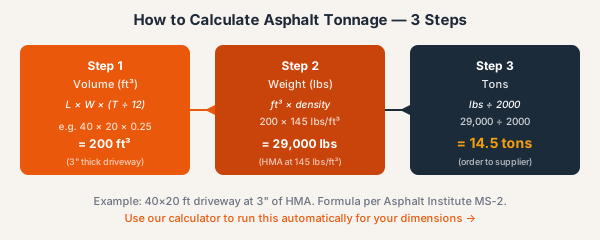
- Calculate volume in cubic feet: Length (ft) × Width (ft) × (Thickness in inches ÷ 12)
- Calculate weight in pounds: Cubic feet × Density (lbs per cubic foot)
- Convert to tons: Pounds ÷ 2000
That's it. Three multiplications and one division.
Why Density Matters
Density is the variable that changes based on asphalt type. Per the Asphalt Institute's MS-2 Mix Design Methods:
- Hot Mix Asphalt (HMA): 145 lbs/ft³
- Warm Mix Asphalt (WMA): 145 lbs/ft³
- Cold Mix / Patch: 140 lbs/ft³
- Porous Asphalt: 125 lbs/ft³
Using the wrong density gives you a wrong answer. A lot of online sources use a generic "145 lbs/ft³" for all asphalt types, which is close enough for HMA and WMA but off by 12% for porous asphalt. Our asphalt tonnage calculator handles this automatically when you select your asphalt type.
Worked Example: Standard Residential Driveway
Project: 40 ft × 20 ft driveway, 3 inches thick, Hot Mix Asphalt
Step 1: Volume in cubic feet:
40 × 20 × (3 ÷ 12) = 40 × 20 × 0.25 = 200 cubic feet
Step 2: Weight in pounds:
200 × 145 = 29,000 pounds
Step 3: Convert to tons:
29,000 ÷ 2000 = 14.5 tons
So the material order for this driveway is 14.5 tons of HMA. Add 5–10% buffer for waste and delivery shortfalls: order 15–16 tons.
This is exactly what our asphalt calculator produces if you enter those dimensions. Verify it yourself.
Worked Example: Medium Parking Lot
Project: 100 ft × 60 ft parking lot, 4 inches thick, Hot Mix Asphalt
Step 1: Volume:
100 × 60 × (4 ÷ 12) = 100 × 60 × 0.333 = 2,000 cubic feet
Step 2: Weight:
2,000 × 145 = 290,000 pounds
Step 3: Tons:
290,000 ÷ 2000 = 145 tons
With a 10% buffer: order 160 tons. That's 8 truck loads at 20 tons per delivery.
Converting to Cubic Yards
If your supplier or contractor quotes in cubic yards rather than tons, the conversion is straightforward:
Cubic yards = Cubic feet ÷ 27
For our driveway example: 200 ÷ 27 = 7.4 cubic yards
Note: cubic yards is less commonly used for asphalt than for concrete. Most asphalt plants quote by the ton.
Why You Need to Add 5–10% Overage
Asphalt quantity estimates assume perfect yield: no material left in the truck, no waste at edges, no variation in thickness. Reality has all three.
- Truck residual: Dump trucks rarely deliver to the pound. Expect 1–3% material stuck in the truck bed.
- Edge waste: Material raked away from edges or joints during finishing is not recoverable.
- Thickness variation: Subgrade irregularities mean some areas get slightly more material than spec.
Contractors typically order 5–10% over the estimated tonnage. For a residential driveway, that's modest: an extra half-ton to a ton. Running short mid-project means delaying to order more material, which creates cold joints that reduce durability.
Calculating Square Feet to Tons Per Inch
If you need a quick mental shorthand:
HMA at 1 inch thick per 100 square feet ≈ 0.60 tons
So for a rough estimate:
- 1,000 sq ft at 2 inches: 0.60 × 10 × 2 = 12 tons
- 1,000 sq ft at 3 inches: 0.60 × 10 × 3 = 18 tons
- 1,000 sq ft at 4 inches: 0.60 × 10 × 4 = 24 tons
This quick rule-of-thumb works for HMA at standard density. For a precise answer, use our asphalt quantity calculator. It runs the full formula and accounts for asphalt type.
Common Mistakes in Manual Calculations
Using the wrong thickness unit: The formula requires thickness in feet, not inches. Divide inches by 12 before multiplying. Forgetting this step makes your answer 12× too large.
Using loose density instead of compacted: Material is weighed and sold by the ton in its loose, truck-delivered state, but placed and measured in its compacted state. The density values above (145 lbs/ft³ for HMA) are compacted values. The formula works correctly because you're calculating compacted volume and using compacted density.
Forgetting non-rectangular shapes: L-shaped driveways, curved sections, and cul-de-sac turnouts need to be broken into rectangles or estimated as separate areas. Add the areas together before running the formula.
Using square footage from a satellite map without adjusting for scale: Satellite measurements are often slightly off. Physical measurement with a tape is more accurate for ordering material.
For the fastest and most accurate result, run your numbers through our free asphalt calculator. It handles all the conversions and outputs tons, cubic yards, cost estimate, and truck load count in one calculation.